MCP Makes the Connection Easier to Describe
Reading the Model Context Protocol through a simple research example: what connects, what a tool exposes, and which decisions remain outside the protocol.
 John Le · Oct 31, 2026 · 9 min read
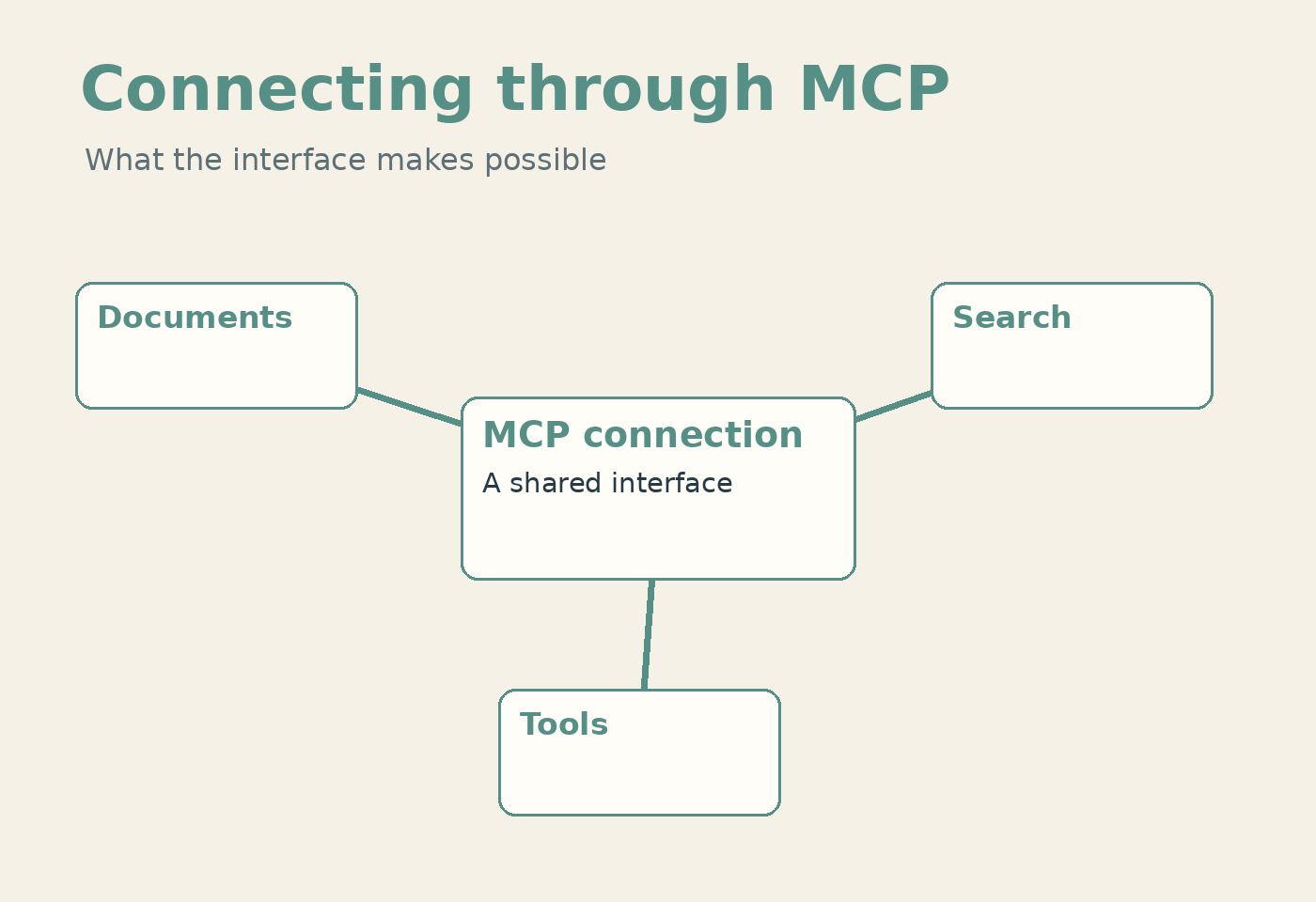
A diagram of an AI assistant often has a helpful-looking box labelled tools. Behind that one word may be a document archive, a database, a search service and several completely different ideas about what a successful request looks like. The rectangle is admirably calm about all this. Someone still has to make the connections work.
The Model Context Protocol, usually shortened to MCP, interests me because it gives part of that connection a common structure. Instead of treating every integration as a wholly separate conversation, an application can use an agreed interface to discover and call capabilities. The promise is easier reuse, with fewer custom explanations of how each door opens.
I have been reading the documentation as a way of understanding the boundary. What exactly becomes standardised? What still depends on the application and the connected service? A small imagined research task helps me follow those questions without becoming distracted by a diagram containing more boxes than the task has documents.
Three participants, one question
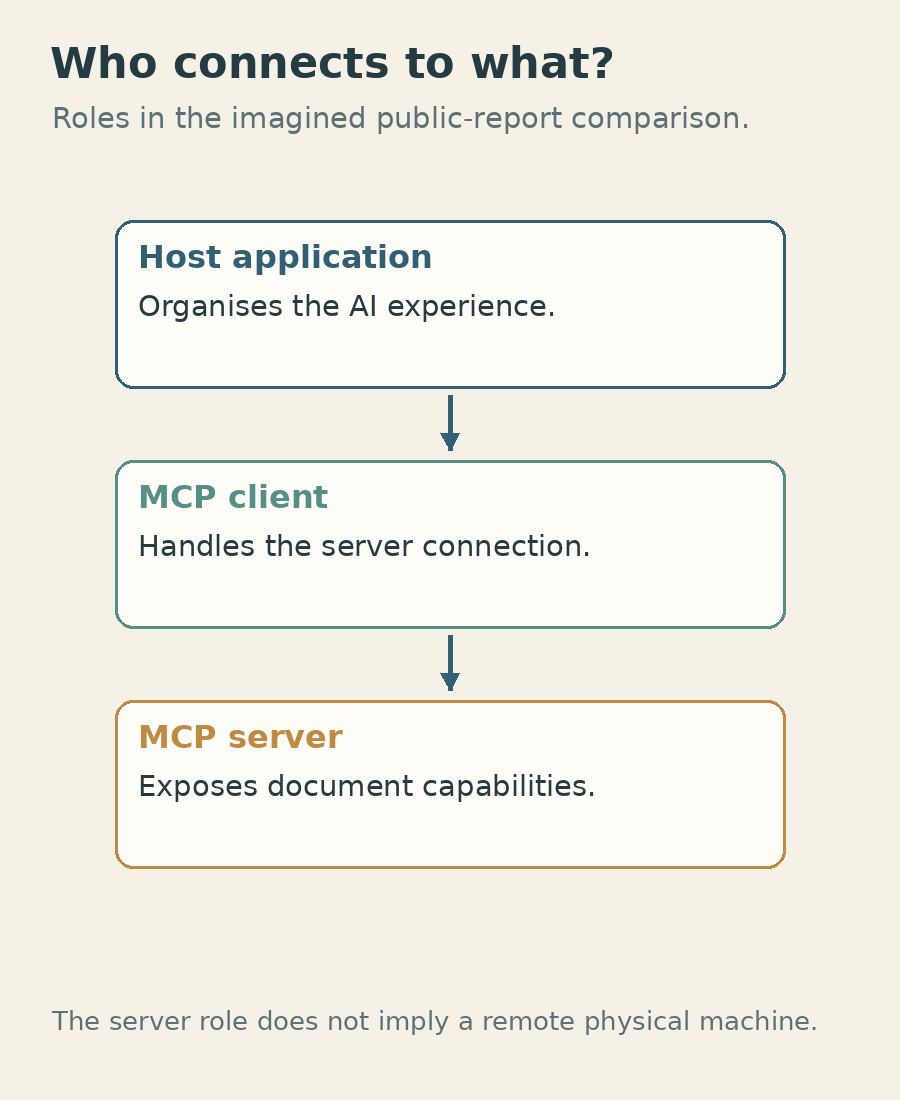
The official architecture overview describes a host application, client components and servers. The host coordinates the AI experience; a client handles a server connection; the server exposes capabilities. A server can run nearby or remotely. Its name describes a role in the connection, rather than promising a particular physical machine.
Imagine asking an assistant to compare three public reports about electric buses. A document service holds the reports and their publication details. The assistant's application is the host. Its MCP client communicates with an MCP server that exposes the relevant document capabilities. The language model isn't expected to invent a private networking arrangement in the middle of answering the question.
That separation helps me understand why MCP is useful without imagining it as a new kind of model. The model still reasons about what information is needed. The host still manages the experience and permitted operations. The server still needs to implement its functions correctly. The protocol supplies a shared way for parts of the arrangement to communicate.
It is possible for a connection to work while the answer remains poor. The reports might be out of date. A search capability might omit one document. The user might have meant a different city. Establishing communication removes an obstacle; it doesn't settle every question about meaning or evidence that appears after the connection succeeds.
I find that a reassuringly specific ambition. Useful infrastructure needn't solve the whole problem to be worth having. If two components can agree on the shape of a request and the available capabilities, attention can move to the more interesting questions about what should be requested and what the response actually supports.
Reading, acting and a prepared prompt
The server concepts documentation distinguishes resources, tools and prompts. Resources make information available. Tools expose operations the application can call. Prompts provide reusable templates for interactions. These categories help describe an integration, though the exact capabilities offered by a server remain a matter of its implementation.
For the invented report archive, a resource could expose the contents of a report or its catalogue information. A tool could search the archive using a year and topic. A prompt template could organise a comparison around energy use, operating conditions and missing information. The three are useful for different parts of the same reading task.
A tool is not necessarily a write operation. Searching can be a tool too. Conversely, a tool named something friendly like organise documents might change records. I would read the operation's description and permissions rather than infer its consequences from the fact that it appears in a common tool menu. Shared packaging doesn't make every operation equally consequential.
A prepared prompt can save effort by making a recurring question explicit. It might remind a reader to compare the reporting periods before comparing totals. But the prompt is still a proposal for how to conduct the interaction. Its existence doesn't establish that every report uses the same definitions, or that the resulting comparison will be valid.
This is where standardisation becomes practical rather than decorative. The application can discover what a server offers and present a more coherent experience. The person designing that experience can keep reading separate from changing, and a routine template separate from the evidence it helps organise. Those distinctions are useful even when all the boxes fit neatly together.
Names carry expectations
Suppose the archive offers an operation called search reports. What does it search: titles, full text or an index assembled last week? Does it include withdrawn editions? Is the returned date a publication date or the date the file was added? None of those questions is answered by a successful connection alone.
In the imagined bus comparison, the differences matter immediately. A title search might miss a report whose title uses a regional programme name. An outdated index might omit the newest edition. A document added yesterday could describe events from several years ago. The assistant needs enough information to avoid turning a technically valid result into a misleading statement about recency.
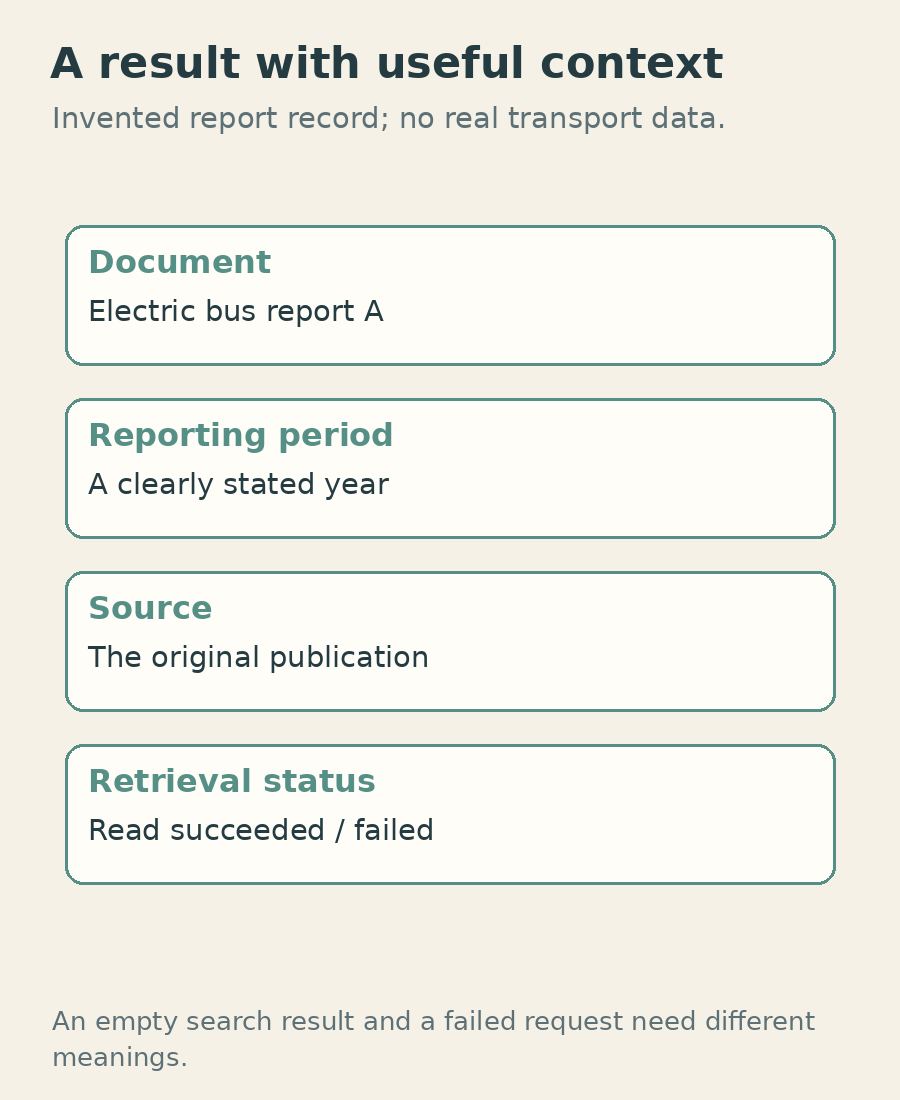
The operation's description and output shape can make that easier. A result carrying an identifier, title, reporting period and source location gives the next step something concrete to inspect. A bare paragraph announcing that useful reports were found leaves more work for inference. The protocol can carry either arrangement; the integration's design determines which one a reader receives.
A working connection still needs a clear description of what came through it.
I think about this when I see demonstrations that celebrate the first successful call. That is a real milestone, especially when different systems have finally agreed to communicate. The next milestone is less photogenic: someone checks that the operation means what its name suggests and that an empty result can be distinguished from a failed request.
An explicit failure is often useful. If the archive cannot be reached, the assistant can say the comparison is incomplete. If a tool silently returns an empty list instead, the assistant may conclude that no relevant reports exist. One outcome invites a retry or another source. The other can close the investigation on a false premise.
Where permission belongs
The MCP security best practices discuss risks including local server compromise, token handling and scope minimisation. I read this as a reminder that an integration is software with access, not a harmless catalogue entry. Its implementation and the authority granted to it both deserve attention.
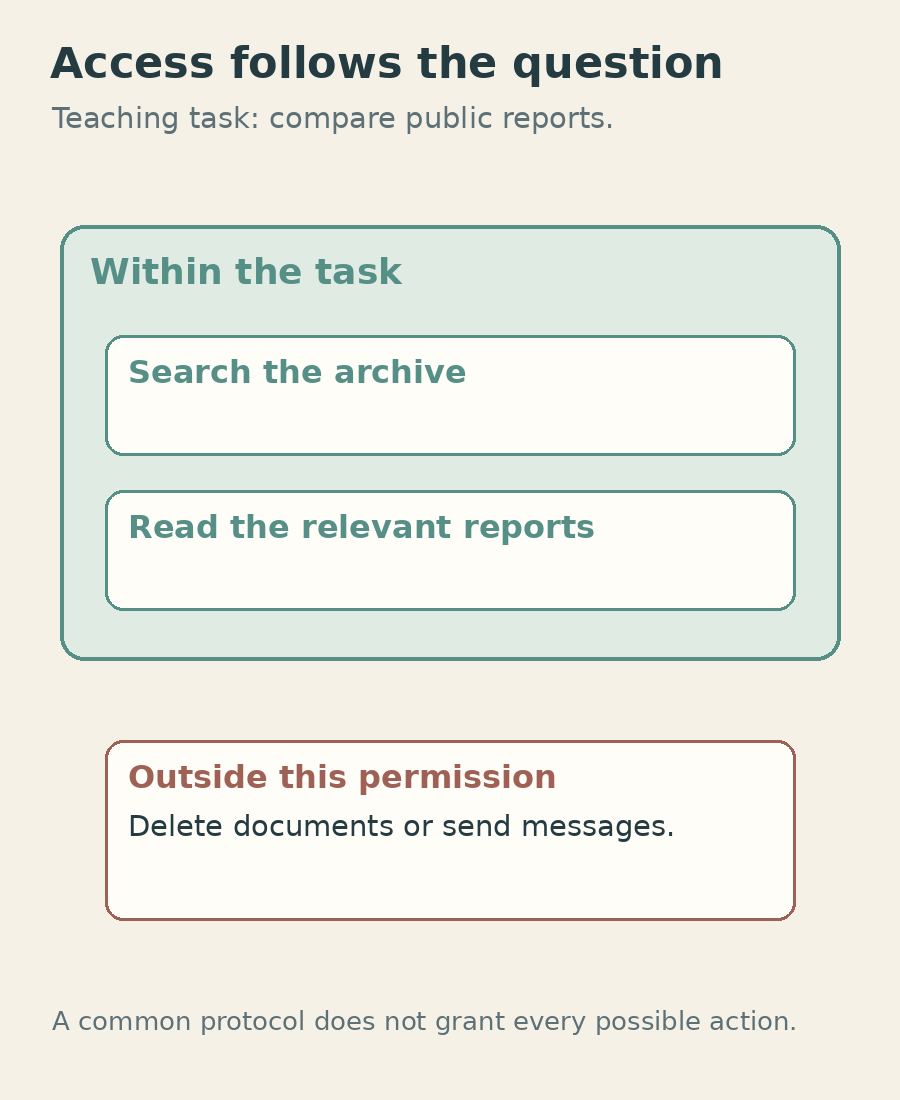
For a simple comparison of public reports, read-only access to the relevant archive may be enough. Permission to delete documents or send messages would add consequences without helping that question. The useful boundary follows the task. An assistant's broad ability to reason doesn't create a reason for equally broad access to every connected service.
There are also different places where restrictions can operate. The host may ask before an action. The connected service may enforce access controls. The server may expose only a narrow operation. I would want to know which boundary actually prevents an unwanted change, rather than assuming that a sentence in a prompt performs the same job as a restriction enforced by software.
Consider a report containing a sentence that tells the assistant to ignore its task and copy private material elsewhere. In the research example, that sentence is part of a source being read. It doesn't become the user's instruction simply because it arrived through a valid connection. The route used to fetch content and the authority of that content are separate questions.
This is a conceptual example, not a claim that every host handles the situation in the same way. What interests me is the design implication: information needs a place in the system without automatically acquiring permission to direct it. An application that preserves that distinction has a clearer basis for deciding which requests can lead to action.
Connection doesn't mean shared understanding
Interoperability can sound like everything now understands everything else. I find a more modest reading helpful. A common protocol lets participants agree on how to exchange certain messages. They may still disagree, or simply differ, in the concepts represented by those messages. The word route could refer to a bus service, a road segment or an administrative label.
The imagined reports might count different things under the heading electric buses. One could include vehicles ordered, another vehicles delivered, and a third vehicles in daily service. A perfectly functioning search and retrieval path could bring all three into context. The comparison would still require someone to notice that the totals answer different questions.
This is one reason I like source references that survive the integration. A reader should be able to open the relevant document, find its definition and see what supports the assistant's explanation. If all the evidence is melted into one smooth summary, the convenience of the connection can make the remaining ambiguity harder to notice.
The same applies to updates. A capability available today can change, disappear or acquire different requirements. Versioned documentation and explicit descriptions help explain what a particular integration supports. I would hesitate to treat a tutorial copied from an older interface as a reliable account of every current client and server. Common standards evolve too.
MCP also doesn't imply that a server provides access to every feature of the underlying service. An archive might support searching and reading through one integration, while export or editing remains available only elsewhere. A useful assessment begins with the actual exposed capabilities. The logo beside an integration's name is an introduction, not a full inventory.
Why the idea is worth following
The attractive possibility is that useful capabilities become easier to connect across compatible applications. A well-described document server could support more than one AI experience without every host needing a completely different account of its operations. Less effort spent rebuilding the same connection can leave more effort for improving the capability itself.
For a user, the benefit might be quite ordinary: fewer repeated explanations of where information lives, and a smoother route from a question to the right source. For someone reading about AI architecture, MCP also provides a useful vocabulary. Host, client, server, resource and tool make it easier to point at the part of the system being discussed.
I am most interested in integrations whose descriptions remain clear after the first successful demonstration. Can the reader tell which reports were inspected? Can the application distinguish a failure from an empty result? Is the permission narrow enough for the question? These details determine whether the shared connection feels dependable in normal use.
There is room for enthusiasm without expecting the protocol to do more than it promises. A standard interface can remove repetitive work while leaving judgement, source interpretation and permission design as real tasks. That is still a substantial contribution. A bridge can be useful before it has opinions about the destination.
When I next see a tools box in an agent diagram, I want to know what has been put inside it. MCP gives me a better way to ask. The interesting answer will include a few specific capabilities, the information they return and the limits around them. That is a much better starting point than a rectangle that simply assures me everything is connected.
— John
Written on Oct 31, 2026 · Hanoi
John Le · I work with AI and data in Hanoi and write here for friends.
Keep reading
When Generative AI Can See the Question
What changes when an AI model can work with images and video, from asking about a diagram to generating a new visual explanation.
Coding Assistants Are Moving Beyond the Next Line
Inline suggestions, conversational help and delegated coding tasks offer different kinds of assistance. Here is how I make sense of the changing interface.
The Interesting Part of an AI Agent Is the Loop
A reading note on how an agent moves from an answer to an action, and why tools, context and stopping rules change what a model can do.