Hanoi, Slowly: A Weekend as a Visitor in My Own City
Looking at Hanoi again before our daughter arrives: dawn by the lake, the new metro, a train to Ninh Bình, and flowers for my wife on 20 October.
 John Le · Oct 20, 2024 · 12 min read
In early October my friend Thảo messaged me from Sài Gòn. She was coming to Hanoi for a week in November, her first time in the north, and she wanted a list. "You live there. Tell me what to do."
I opened my notes and typed walk around the lake, eat phở, egg coffee. Then I stopped. I ride past Hoàn Kiếm most weeks and I eat phở most mornings, but I couldn't remember the last time I had walked around the lake slowly, for no reason, with my eyes open. Probably as a teenager, because of a girl.
I grew up in Đồng Hới, in Quảng Bình, where my parents still live. Hanoi came later: university, a rented room in Cầu Giấy, then the return in 2021 after three years studying in Moscow. I have spent enough years here to complain about a new road before I have used it. Apparently that doesn't qualify me to suggest a decent Saturday.
So I gave myself a weekend in the middle of October to be a visitor. Alarm at five, laptop at home, everything on foot, on the metro, or on my motorbike at grandmother speed. My wife is about eight months pregnant. She declined the five o'clock start, asked me to bring breakfast home, and said I could begin my new life as a thoughtful husband with that. Each evening I'd write notes for Thảo.
The lake belongs to the old people until seven
Hoàn Kiếm at half past five on a Saturday is a different lake from the one I ride past. The sky was grey-blue, the Turtle Tower was a dark shape on its island, and the Thê Húc bridge looked more brown than red.
Women in matching red T-shirts did a fan dance to an old song from a speaker tied to a tree. Two men played badminton across the pavement with no net, only an agreement about where a net would be, and they argued about it every third point. Under the big trees a group did tai chi so slowly they seemed to be waiting for something. A man by a bench was slapping his own arms and chest, hard, as if they had disappointed him. It's for circulation. It looked like he was putting out a small fire.
An old man with one leg up on the railing saw my phone and said, "Chụp đi, chụp đi," go on, take one, and held the stretch until I did. Then he asked where I lived. I said the western side of the city, about half an hour away that early.
"Half an hour? Then why have I never seen you here?"
I didn't have an answer.
By seven the motorbikes own the road again and the dancers are folding their fans into their handbags. The best time for the lake is before half past six, or a weekend evening, when the streets around it close to traffic and the whole city brings its children out to walk.
After that I needed to sit, and Hanoi's answer is a plastic stool the height of a shoebox next to a woman with a big glass jar of iced tea. A cup of trà đá costs about five thousand dong, roughly twenty cents. For that you get weak green tea over ice, a seat on the pavement and permission to stay as long as you like. Your knees end up near your chin. You pay when you leave, and if you took sunflower seeds from the plate, she knows how many.
From a low stool the traffic sounds like a conversation. One short beep means I'm here. Two mean I'm passing, don't move. A man with a refrigerator strapped upright behind him slid through a gap that did not exist, and the bus behind him slowed by exactly the right amount. Nobody shouted.
That became a note for Thảo: watch how people cross, wait for a sensible gap, and don't expect a green light to mean every vehicle has stopped. My mother used to hold my wrist when we crossed the roads in Đồng Hới. I could almost feel her grip again from that stool.
Rooftops from the new train
In the afternoon I rode both metro lines from end to end, for the windows. The Cát Linh to Hà Đông line has been running for a few years, and the elevated section from Nhổn to Cầu Giấy opened this August. From up there Hanoi is a sea of narrow tube houses, four or five floors each, almost every roof with a shiny steel water tank. One roof had a man doing push-ups next to his laundry.
The trains are clean, cold and very quiet, and people speak a little too softly, as if they were in a hospital. An old woman next to me held the pole with both hands and watched the rooftops slide past like a child at the zoo. Her grandson, maybe five, was explaining everything to her. "That's a school, bà. That's a crane." She let him.
Tickets are cheap, but neither line reaches the Old Quarter yet. Ride it for the view and an hour of air conditioning, then take a Grab back to the lake.
West Lake and the first cold wind
In the evening I rode to West Lake, where the wind smells of water and of the bánh tôm stalls, shrimp and sweet potato fritters that are mostly an excuse to sit facing the lake. On Thanh Niên road couples sit on parked motorbikes looking at the water and not talking, and men fish and catch nothing, with enormous patience.
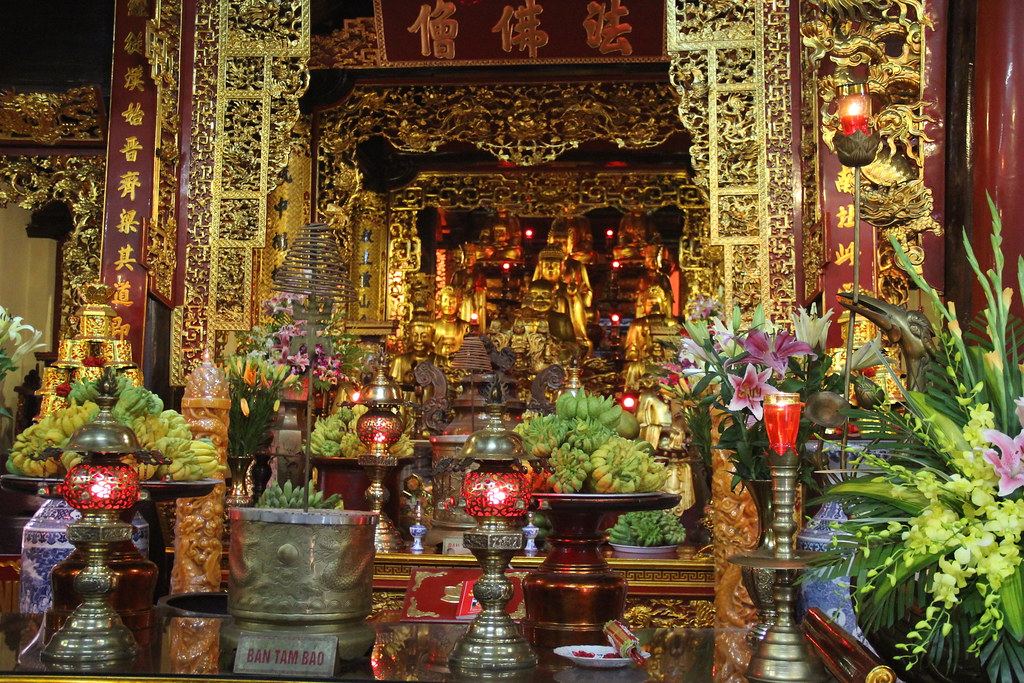
Trấn Quốc pagoda sits just off that road on a little island at the end of a short causeway. People say it is the oldest pagoda in Hanoi, nearly fifteen hundred years old, though it has been moved and rebuilt more than once. Inside it is smaller and quieter than the photos suggest, with a big bodhi tree and a tall red tower that has a small Buddha sitting in each arched window. Cover your knees and shoulders, and don't climb on anything for a photo. I watched a monk gently tell off a young man for exactly that. He apologised with both palms together and went pink to the ears.
The first gió mùa of the year had arrived that week, or at least everyone at work said so. The air gets dry and thin and the lake turns a darker colour. People say "Gió mùa về rồi," the cold wind is back, in the voice you'd use for a relative who came up from the countryside without calling first. My mother texted me "Mặc ấm vào con," dress warm, when it was twenty-four degrees.
October nights also bring hoa sữa, the milk flower. The trees along Nguyễn Du street smell especially strong after dark, heavy and sweet, like perfume in a closed lift. Half the city loves it and the other half gets headaches. My wife closes our windows when the smell gets too strong. I rode down Nguyễn Du twice that night, slowly, then went home before the food she'd asked for got cold.
Long Biên before anyone needs it
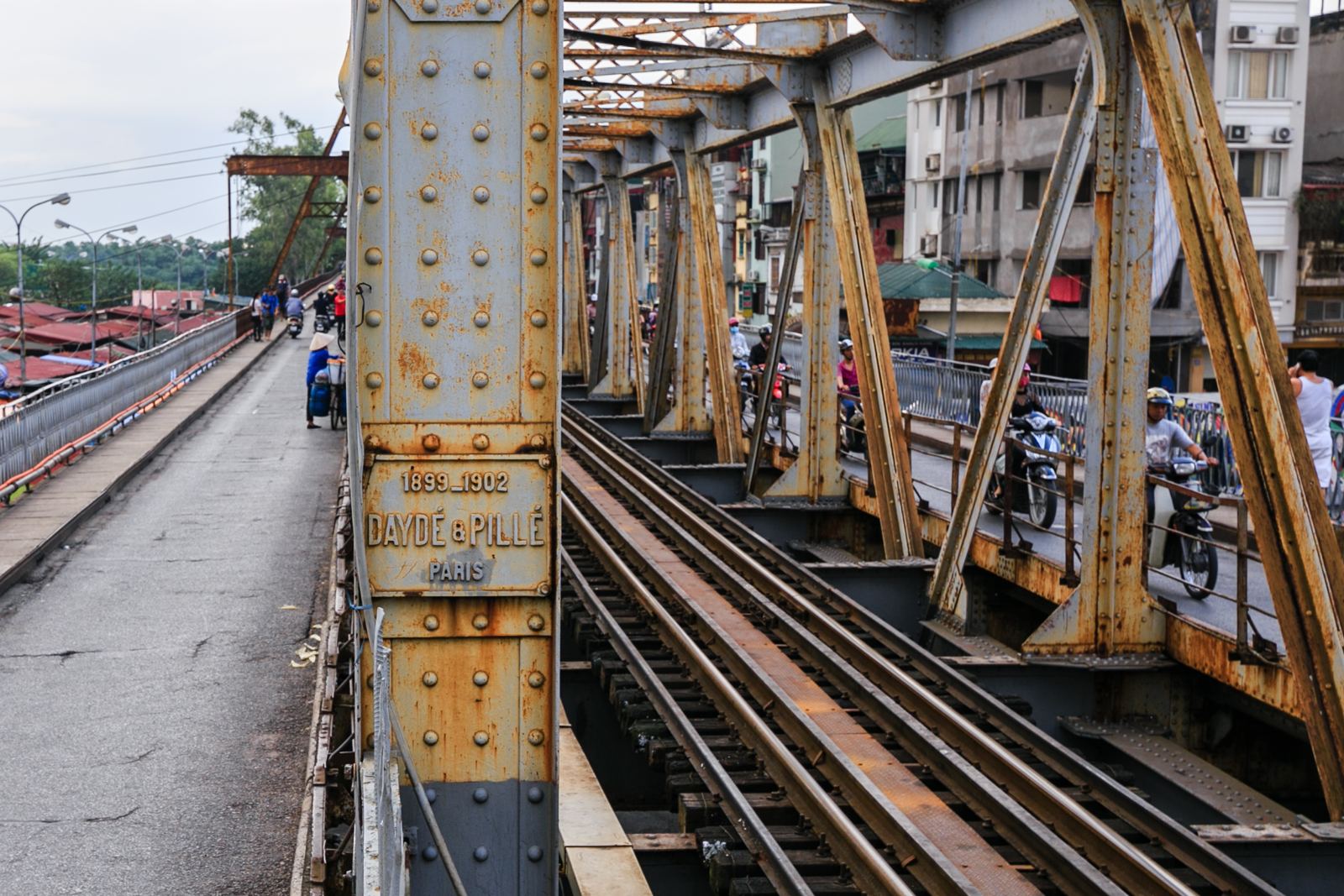
On Sunday I was at Long Biên bridge before five. It opened in 1902, and it looks every year of it: a long rust-brown spine of steel across the Red River, with a narrow walkway beside the traffic. Trains use the middle. I stayed well away from the tracks and watched the bicycles coming into town.
The first people across were women on old bicycles with baskets of flowers and greens, pedalling into town to sell them. None of them looked at the view. A train came across from the far bank, slow, with a long hoarse horn, and the whole bridge shivered under my sandals. Nobody else looked up. I did, both times a train came.
On the sandbank below, the banana trees were still lying flat and grey with mud from the typhoon in September, and a few people were already out there with hoes, starting again. The sun came up small and red through the haze. My photo of it looks like nothing. Long Biên is the shaking, the rattle of the slabs and the smell of the river, and the phone keeps none of that.
Note for Thảo: wear real shoes, because some slabs have gaps, and stay on the walkway when a train comes. You will feel it before you hear it.
I walked back into the Old Quarter as it was waking up, which I now think is its best hour, and the one visitors miss because they are asleep in hotels on the same streets. Motorbikes that slept in the living room get wheeled out one by one until there is no pavement left.
Phở first, at a place with long benches where you sit facing strangers and their soup. Phở bò tái, rare beef, pink when the bowl lands and grey by your second spoon, with garlic vinegar, chilli and quẩy, fried dough sticks you tear up and drop into the broth. A bowl was fifty thousand. The man opposite added so much garlic vinegar that my eyes watered for him. Good places sell out by nine or ten, so go early, and go where the stools are full of people over fifty.
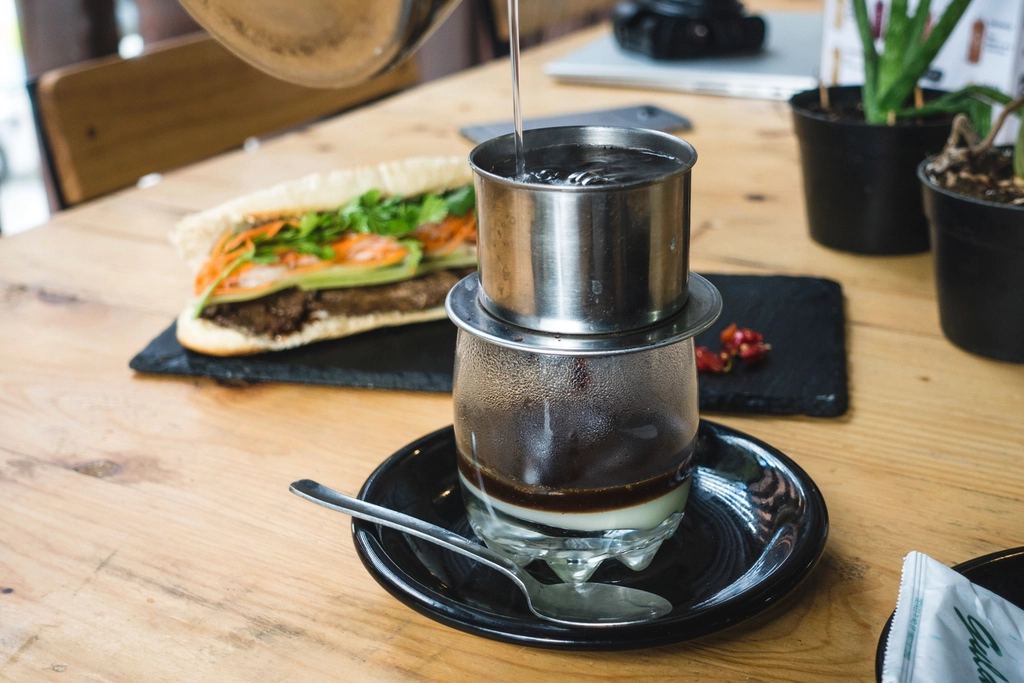
Then egg coffee, which I hadn't ordered in years because it felt like something for guests. Egg yolk beaten with sugar and condensed milk into a warm cream, poured over strong coffee. At the old place on Nguyễn Hữu Huân the cup comes standing in a small bowl of hot water, and you eat the top with a spoon first. It tastes like tiramisu that grew up in the countryside. I meant to stay ten minutes and stayed forty, which in my normal week would count as an emergency.
A boat with Hưng
The following Saturday I took the six o'clock train to Ninh Bình with my friend Hưng, who came on the condition that I would not make him get up at five again. I did. The ride is a little over two hours, past rice fields with family graves standing in the middle of them.
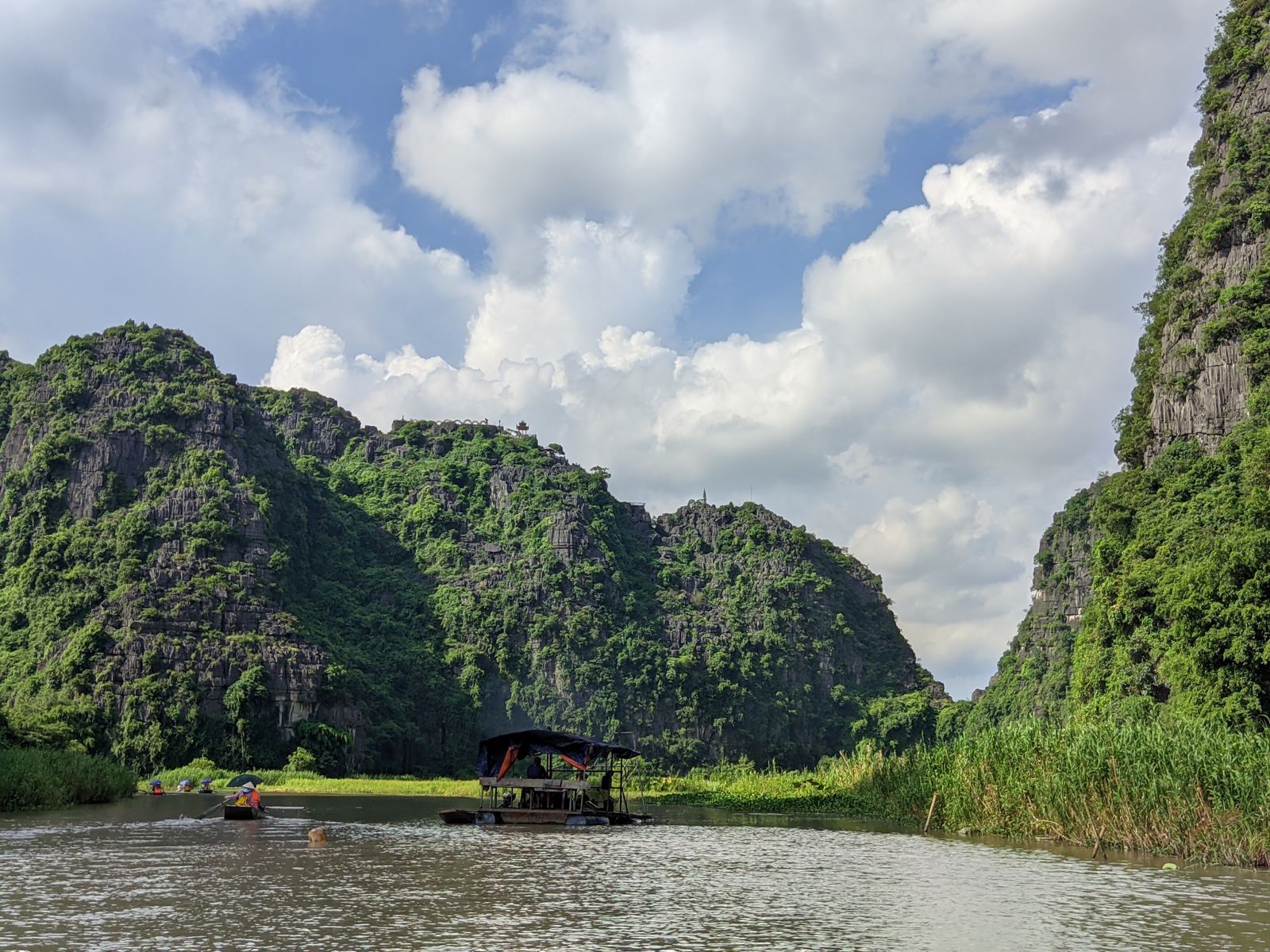
From the station we took a Grab to Tràng An. The boats are small and flat, four passengers and a rower, and the route runs through a chain of caves between limestone towers that come straight up out of the water. Tickets were two hundred and fifty thousand each, and the longer route took about two and a half hours. Bring water and a hat, and use the toilet before you get in.
Our rower was a woman of about fifty in a conical hat. In the caves she worked the oars with short movements. Some ceilings were low enough that we leaned back while the wet rock slid over our heads. In the darkest one a drop landed on Hưng's neck and he made a sound I will remember for the rest of my life. On the open stretches she settled into longer strokes. Once she rested an oar to point at a goat standing on a cliff where no goat should be.
"Doesn't it hurt?" Hưng asked.
"Of course," she said. "But the boat still has to get back."
She knew exactly which cave would drip, and she always warned us half a second after it landed. I'm almost sure that was on purpose.
In the afternoon we climbed Hang Múa, about five hundred stone steps up a steep ridge to a stone dragon lying along the top. Go around four, when the heat drops, and expect to queue for the same photo of the dragon as everybody else. From the top the rocks stand in rows into the haze and the Ngô Đồng river curls between them. In October the fields below were a patchwork, some cut to stubble, some flooded and full of sky. The woman at the ticket gate said the famous yellow rice is late May to early June. "Come back then," she said, as if she would personally arrange it.
Flowers at home
Today is the twentieth of October, Vietnamese Women's Day. This afternoon I bought flowers for my wife from a woman with a bicycle full of them. She wrapped the stems in newspaper, then added another sheet because I was going home by motorbike. I carried them into our flat with the price still tucked inside. My wife found it immediately.
We put the flowers in a water jug because the vase had disappeared behind a growing collection of baby things. There are tiny clothes drying by the window now. A folded towel occupies the chair where I used to drop my bag. We still have a few weeks before our daughter arrives, but the flat has already begun making room for her.
Then I called my mother in Quảng Bình. She had been to the market early, as usual, and wanted to know whether my wife was eating properly. My father called something from the other end of their kitchen. I asked her to put the phone on speaker so my wife could hear. For a while all four of us talked at once.
I couldn't take flowers down to Đồng Hới this evening. I could stay on the call instead of saying I was busy after five minutes. My mother showed us the fish she'd bought, held the camera too close, then turned it the wrong way round. My wife laughed and talked her through the buttons. I sat beside her on the sofa and held the phone while she rested a hand on her stomach.
While I waited I sent Thảo my notes, far longer than a list. She replied: "You live there and you write like a tourist." I took it as a compliment.
"Ăn cơm chưa?" my mother asked again. Have you eaten?
"Chưa ạ." Not yet.
"Thì ăn đi, để nguội mất." Then eat, before it gets cold.
She was several hundred kilometres away, still trying to get dinner on our table. I set the phone against the water jug. Behind it, the flowers leaned toward the kitchen light.
— John
Written on Oct 20, 2024 · Hanoi
John Le · I work with AI and data in Hanoi and write here for friends.